The Tempest by William Shakespeare
The Royal Shakespeare Company , dir. by Richard Eyre
6th June 2026
Kenneth Branagh’s return to the RSC stage was always going to be a big deal so it was no surprise that this production sold out before it started playing. I wasn’t quite sure what to expect, however. I was certainly keen to see such an old school titan of the stage but the reasons for my excitement were also the reason for my concern. As part of my teaching at university, I had shown students an excerpt from the film of Henry V and watching the patriotic fervour with which Branagh played that character had made me wonder how traditional this Tempest was going to be. By the end of the performance I felt that my concerns were justified. My ten-year-old self would have loved this production, which certainly leans into the magic and mysticism of the play, using the full force of special effects to bring them to life. My forty-year-old self wondered what exactly, beyond allowing Branagh the chance to play Prospero, the production had been trying to say.
Certainly the beginning of the performance took full advantage of their main star. Branagh walked on to an unadorned stage, picked up a conductor’s baton and with a downward stroke began the action. There was no doubt for me that it was an impressive opening. The stage transformed into a lashing ocean, a hatch threw open in the centre of a central moveable disc, which immediately starting rocking and rolling as sailors climbed out to contend with the ocean. The visual effects were so powerful it almost felt cinematic and Branagh was clearly in charge, using the baton as a wand and donning a magical cloak to emphasise his power. The conventionality of this cloak, however, rekindled my worries about the production. This magical item was a lovely deep blue, embroidered with stars and moons and draping beautifully from his arms. It was straight out of a children’s picture book which, while speaking strongly to my child self again, felt almost abrasively stereotypical in its signalling of ‘magic’. There was little new being said or explored here.
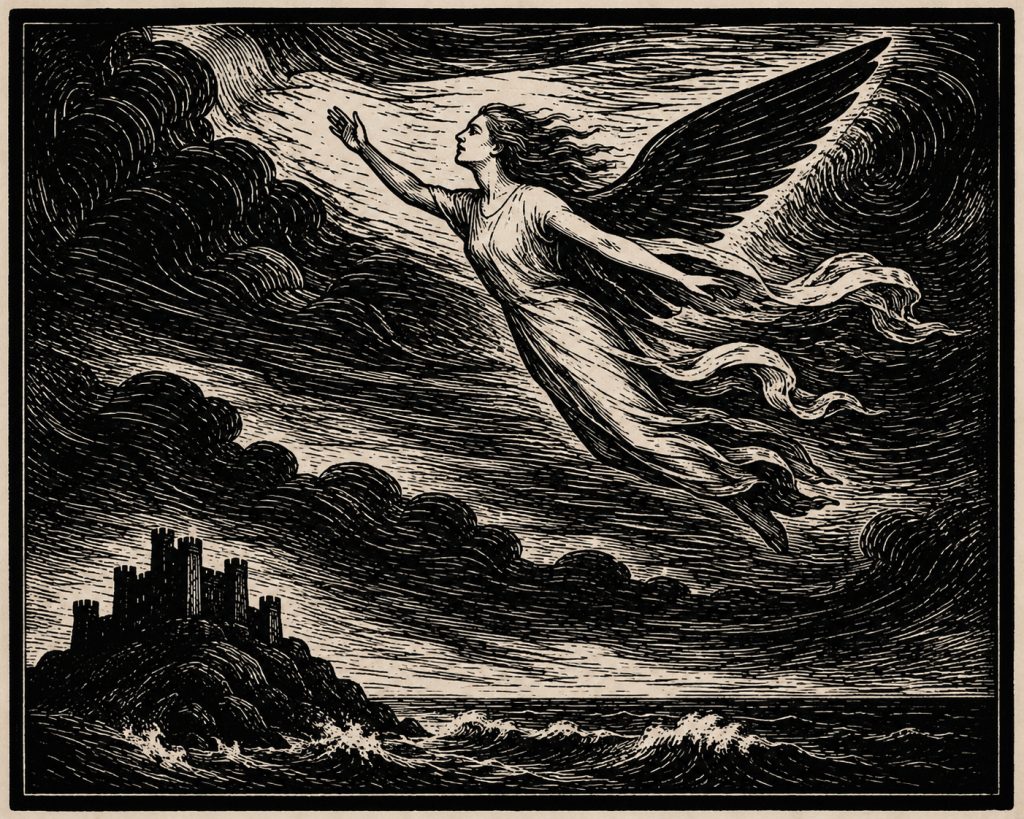
The casting too was extremely conventional and again required no imaginative effort from the audience. Boys were playing boys here and girls were playing girls, which meant that Miranda, Arial and two of the three spirits were the only female influences on the stage. To emphasise her magical nature, Arial flew throughout the play. I personally felt that the clunky harness that held up Amara Okereke somewhat distracted from her ethereal presentation but there was no doubt she moved through the air with skill. Carrying on with the almost deliberately conservative casting, there were white actors representing the nobles of Milan and black actors used for the original inhabitants of the island. This felt uncomfortable, I think largely because not enough was made of the reasons behind it. Turning to the programme, the director Richard Eyre notes that ‘having been marinated in the dissolution of the British Empire, I came to see the world of the play through a post-colonial lens… This element is unignorable’. Certainly, he worked hard to give Caliban the dignity he is so often denied. This was no monster but clearly an enslaved inhabitant of the island and Ashley Zhangazha played the part with a sense of intelligent purpose. Yet, Prospero’s treatment of Caliban was glossed over, Caliban’s anger dissipated by the end of the production and there was no sense of interrogating the cruelty that Caliban hints at or what it meant for him that Prospero had so willingly enslaved another.
I am reminded here to think of Nora J. Williams’ concept of ‘incomplete dramaturgy’. If Eyre wanted to say something about slavery, then he should have gone fully into it and been willing to explore its deep, dark places, rather than presenting this romanticised version where the enslaved don’t seem too badly done by and the slaver almost benevolent in his forgiveness. Instead, Eyre just sees it as a single element, of equal importance to magic and virtue. I’m not sure slavery should be treated this way. In the context of the largely-white, largely-old audience of the RSC, such sidelining felt like it was pandering to the expectations of its conservative audience, reminiscent of old paintings where an enslaved person can often be spotted in a corner, while everyone focuses on the nobles in the middle.
This lack of thorough thought was reflected in the way that Caliban’s interactions with Trinculo and Stephano were staged. Caliban pretended to drink the alcohol offered, remaining sober when others were drunk and deliberately using the other two to carry out his plan to hurt Prospero. Yet, his need to have them as part of his plan then didn’t quite follow through. If this was a strong and capable Caliban, then he would have been more than able to hit Prospero on the head himself. In addition, at the end of the play, Caliban still declared ‘What a thrice-double ass | Was I, to take this drunkard for a god, And worship this dull fool!’. This line simply didn’t make sense in a context where he had been the one in charge. Prospero’s seemingly benevolent forgiveness of this brave Caliban was then played with genteel authenticity. Yet, to me, this seemed more like a rhetorical strategy, gaslighting both Caliban and the audience into forgetting that it was actually up to Caliban to decide whether to forgive Prospero instead.
Yet, within these moments of frustration that the play could have been saying more about slavery, there were also moments of real pleasure. The actors Miranda (Ruby Stokes) and Ferdinand (Fred Woodley-Evans) bought a charm and vivacity to what can often be insipid parts. Ferdinand’s attempts to talk to Miranda when he met her by speaking slowly and using hand gestures were a charming send up of the Englishman abroad (although maybe that should have been Italian – these nobles were from Milan in name only). The two young characters clearly fancied eachother although their continual attempts to get together did make Prospero’s watching eye feel slightly uncomfortably more like that of a pimp than a father.
The ending of the play also again showed Prospero in full charge of the space as he effectively deconstructed the world. Having sent all the nobles offstage, he dropped the backdrop, revealing the RSC backstage area. He unclipped Arial from her harness and gave Caliban ownership of the island. It was interesting to see how awkwardly Arial now stood. Rather than her freedom allowing her to zoom off into the sky, she was now grounded, testing out new shaky limbs on the ground. Caliban stood shocked and unsure. This was perhaps the most honest part of the whole play’s treatment of slavery, how difficult it can be for people to establish new lives if just abandoned in place. This could therefore also have been a strong moment of reflection. With Branagh’s confident narration not being paused to allow space for Caliban and Arial to express themselves, however, it was hard for the audience to also take a moment to think about what it meant. This was a production that tiptoed up to difficult issues but never fully engaged with them, preferring instead to revel in the strength of its main star and the magic that he brought with him.


Leave a comment